The first cold, damp mornings of October have a way of exposing what your brakes have been hiding. A squeal that fades after a few stops, a pedal that pulses on the way down to the river, a faint grind in bridge traffic: these are the moments drivers start asking whether they need pads only or a full brake pad and rotor replacement.
Here at Jack’s Brakes, we’ve helped Quad Cities drivers stop with confidence since 1965, and fall is one of our busiest brake seasons. Drivers from Rock Island bring us the same questions every year. Are my rotors still good? Can they be resurfaced? Should I take care of it before winter?
Below, we cover why fall is hard on brakes, how pads and rotors wear together and the signs that point to new rotors. We also explain how we decide between resurfacing and replacing, how to get ahead of road salt and how our free brake pads offer works.
Why Fall Is Hard on Brakes for Rock Island Drivers: Wet Leaves, Cold Mornings and Bridge Traffic
Fall is a beautiful season here, but it asks a lot of your brakes. Three things stack up at once.
Wet Leaves
Once leaves start dropping, usually in mid-to-late October in our area, wet piles on streets and in gutters create a slick layer that can lengthen stopping distances. Leaves also hold moisture against wheels and brake parts, so components stay damp longer.
Cold Mornings
October lows often dip into the 40s, and the first frost typically arrives in the second half of the month. The National Weather Service Quad Cities office tracks local conditions. Overnight condensation leaves a thin film of rust on rotors, which is why brakes often squeal on cold fall mornings for the first few stops. That’s usually harmless, but it can hide real wear.
Bridge Traffic
Crossing the Centennial, I-74 or I-280 bridges means slow traffic, long approaches and repeated stops. Every stop turns motion into heat, and heat speeds up pad wear and creates uneven rotor surfaces. Bridge decks also freeze before regular roads, so your brakes need to be at their best as temperatures fall.
Pads vs. Rotors: What Each Part Does and How They Wear Together
Your brakes are a friction system. When you press the pedal, the caliper squeezes two pads against a spinning metal disc called the rotor, and that friction slows the wheel. Pads are the sacrificial part, made of a softer friction material that wears gradually. Rotors are cast iron and last longer, but they wear a little every time the pads clamp down.
How long each part lasts depends on how and where you drive. Pad life is often quoted at somewhere between 30,000 and 70,000 miles. Stop-and-go driving, towing, heavy loads and pad material can move that number a lot. Rotors often outlast one set of pads, though not always.
The key point is that pads and rotors wear as a pair. New pads need a flat, smooth surface to bed into. If a brake pads replacement goes onto a rotor that’s scored, glazed or uneven, the new pads can wear unevenly, make noise and fall short on stopping power. So, do you need new rotors when replacing brake pads? Not always, but every rotor should be measured and inspected first.
Warning Signs You Need New Rotors as Well as Pads: Pulsing Pedal, Grinding, Scoring and Vibration
Some symptoms point to pads alone. Others tell us the rotors are involved too.
- Pulsing pedal: A pedal that throbs under your foot usually means the rotor’s thickness has become uneven. People often call these warped brake rotors, but the cause is usually uneven pad deposits or thickness variation rather than true warping.
- Grinding: A harsh metallic grind often means the pad is worn down to its backing plate. Metal on metal cuts grooves into the rotor quickly, and brake rotor replacement usually follows.
- Scoring: Deep grooves or a raised lip around the rotor’s outer edge signal heavy wear.
- Vibration: A shaking steering wheel when you brake from highway speed often points to the front rotors.
- Constant squealing: A high-pitched squeal that continues after the brakes warm up is often the built-in wear indicator.
Signs of warped rotors can feel stronger in cold weather, when cold metal and morning moisture exaggerate pulsing and noise. A pull to one side, a soft pedal or a brake warning light needs attention right away, because those can point to caliper, hose or fluid problems. If a shake seems tied to your tires or alignment rather than your brakes, our suspension, steering and tire service can track it down.
Resurface or Replace? How Our Technicians Measure Rotors and Decide
Every rotor has a minimum thickness set by its manufacturer, often called the discard thickness. It’s usually stamped right on the rotor. When your vehicle comes in, our technicians pull the wheels, inspect the pads, calipers and hardware, and measure each rotor at several points. We also check runout (side-to-side wobble) and thickness variation.
When Resurfacing Makes Sense
If a rotor is comfortably above minimum thickness and has only light glazing or minor marks, machining can restore a smooth, flat surface. The rotor has to stay above minimum after it’s cut, not just before.
When Replacing Is the Better Call
Many modern rotors are thinner and lighter than older designs, so there’s little material to spare. If a rotor is at or near minimum, deeply scored, cracked, heat-spotted or rusted at the edges, brake pad and rotor replacement is usually the smarter choice. New rotors are often reasonably priced compared with machining one that may not last.
Here at Jack’s Brakes, we show you the measurements and explain what we found before any work starts. Large trucks, RVs and fleet vehicles get the same careful process, and heavy-duty work is a big part of what we do.
Getting Ahead of Road Salt and Winter Rust on Brake Components
Salting usually ramps up in November or December across Illinois, and salt and brine are hard on everything under your vehicle. Salt and moisture together speed up corrosion on rotor faces, the rotor hat and edges, caliper slide pins and brake lines.
Light orange surface rust after rain or a car wash is normal and clears after a few stops. Flaking rust, buildup on the rotor edges or patches that stay rusty are a different story. They can cause uneven braking, noise and faster pad wear.
What You Can Do Now
- Schedule fall brake service in October, before salt hits the roads.
- Ask us to clean and lubricate the caliper slide pins and hardware during brake work.
- Rinse your undercarriage now and then through the winter.
- Drive the vehicle regularly, because cars that sit tend to rust faster.
The NHTSA’s winter driving tips are a helpful checklist for getting your vehicle ready for cold weather. Taking care of your brakes now is usually easier than dealing with seized hardware in January.
Free Brake Pads With Rotors Installed
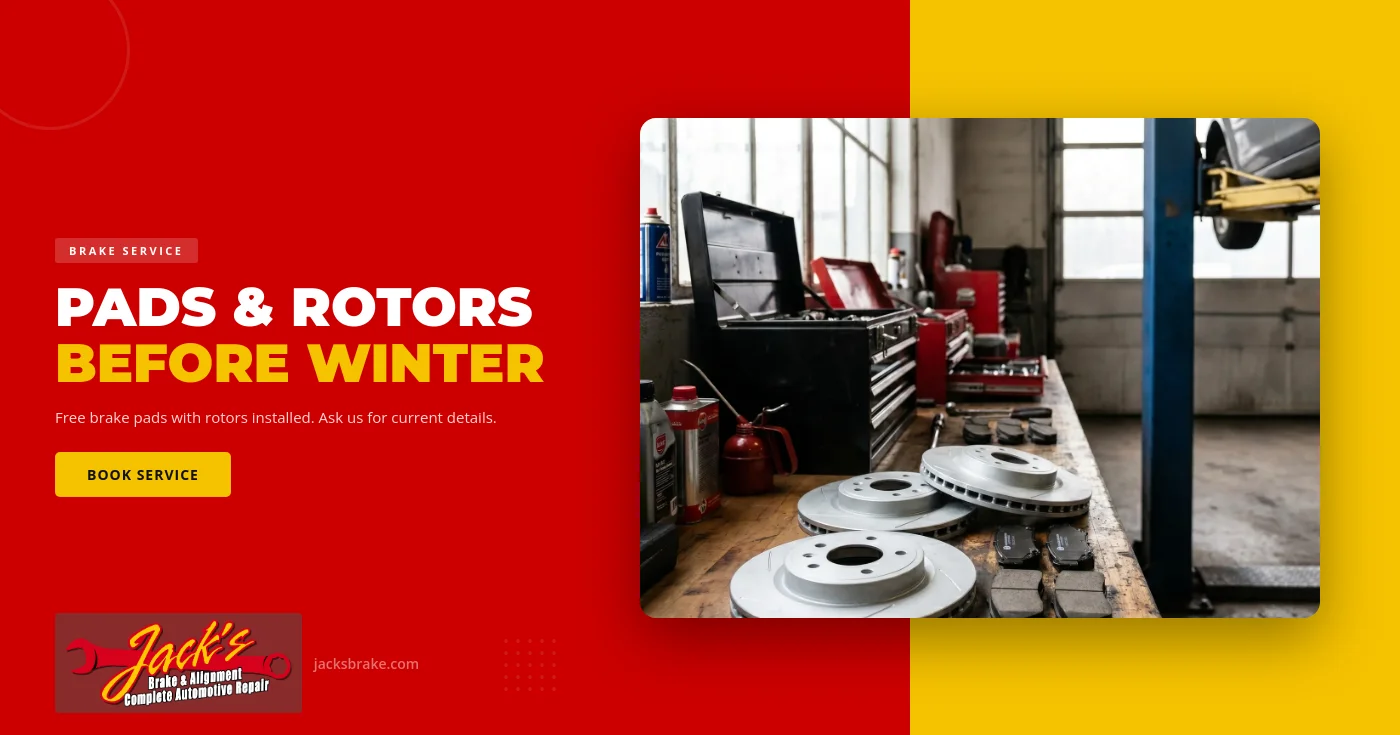
One of our current specials pairs perfectly with fall brake work: free brake pads with rotors installed. Check our website for current details, or ask us how the offer applies to your vehicle.
If your rotors need replacing anyway, this is an easy way to save on pads. Not sure whether you’ll need rotors at all? Bring it in, and we’ll measure everything and give you a free written estimate. If your rotors are still in good shape, we’ll tell you. We won’t push a brake pad and rotor replacement just so you can use the offer.
For other ways to save, check our current coupons and specials, including Jack’s Super Saver Deals on qualifying purchases. Ask us how each offer applies to your visit.
What to Expect at Jack's: Free Estimates, Your Approval Before Any Work, and a 24-Month/24,000-Mile Warranty
As a Quad Cities brake shop for more than six decades, we’ve built our reputation on friendly service, clear communication and fair pricing. Here’s what a brake visit looks like:
- Free estimate. We inspect your brakes and give you a written estimate.
- Your approval first. No work is done without your OK, and our no-surprise-fees policy means you know the price up front.
- Quick availability. Same-day service is available on many routine jobs, and you can book online.
- Warranty coverage. Parts and labor are covered for 24 months or 24,000 miles, backed by the TechNet Nationwide Warranty.
Our climate-controlled waiting area has free WiFi, a TV and a pet-friendly space. If you’d rather not wait, ask about our free loaner cars or free shuttle. We also offer free towing with repair if your vehicle isn’t drivable. We accept all major credit cards and offer financing through Snap Finance and Koalafi.
Our technicians work on domestic, Asian and European cars, diesels, RVs, fleets and heavy-duty trucks.
Frequently Asked Questions About Brake Pad and Rotor Replacement in Rock Island
Do I need new rotors every time I replace my brake pads?
Not always. If the rotors are above minimum thickness, smooth and true, new pads can go on as they are or after resurfacing. We measure every rotor before we recommend anything.
Why do my brakes squeal on cold fall mornings?
Usually the cause is light flash rust from overnight condensation, and it clears after a few stops. If the noise continues once the brakes warm up, it may be the wear indicator, and it’s worth having us check.
How much does brake pad and rotor replacement cost in Rock Island, IL?
It depends on your vehicle, the parts it needs and whether the calipers or hardware need attention. We give free written estimates. Our current special also gets you free brake pads with rotors installed.
Is it okay to keep driving with grinding brakes?
We don’t recommend it. Grinding usually means metal-on-metal contact, which damages rotors quickly and reduces stopping power. Have it checked as soon as possible. If the vehicle isn’t drivable, we offer free towing with repair.
How long do brake pads and rotors last?
It varies widely with driving habits, vehicle weight and the parts used. Regular inspections, such as a quick look during an oil change, are the best way to catch wear early.
Book Your Brake Pad and Rotor Replacement Before Winter
Wet leaves, frosty mornings and the salt season ahead make October the right time to check your brakes. Whether you need pads only or a full brake pad and rotor replacement, we’ll measure, explain your options and let you decide. If you need rotors, you’ll also get free brake pads with our current rotor special.
For 61 years, Jack’s Brakes has served drivers across the Quad Cities from our two locations, including Davenport, Bettendorf, Moline, East Moline, Pleasant Valley and Rock Island. When you need brake repair in Rock Island, IL, contact Jack’s Brakes to schedule your fall brake inspection today.
Do I Need New Rotors When I Replace My Brake Pads?
It’s one of the most common questions we hear in the fall, and the honest answer is not always. Pads and rotors wear as a pair, so we measure every rotor before we recommend anything. If your rotors are above the manufacturer’s minimum thickness and still smooth and true, new pads may be all you need. If they’re worn thin, scored, unevenly worn or rusted at the edges, replacing them along with the pads gives you smooth, confident stops.
Watch for these signs that your rotors may need attention:
- A pulsing brake pedal or a shaking steering wheel when you stop
- Grinding, which often means the pads are down to metal
- Deep grooves or a raised lip on the rotor’s edge
- Squealing that doesn’t fade once the brakes warm up
Cold mornings, wet leaves and the road salt ahead make October a smart time for a brake check. Right now, we’re also offering free brake pads with rotors installed. Ask us for current details.
Every visit starts with a free written estimate, and we never do any work without your approval. Our parts and labor are covered for 24 months or 24,000 miles. For the full rundown on warning signs, resurfacing versus replacing and how to protect your brakes from winter rust, read our complete guide to fall brake pad and rotor replacement.