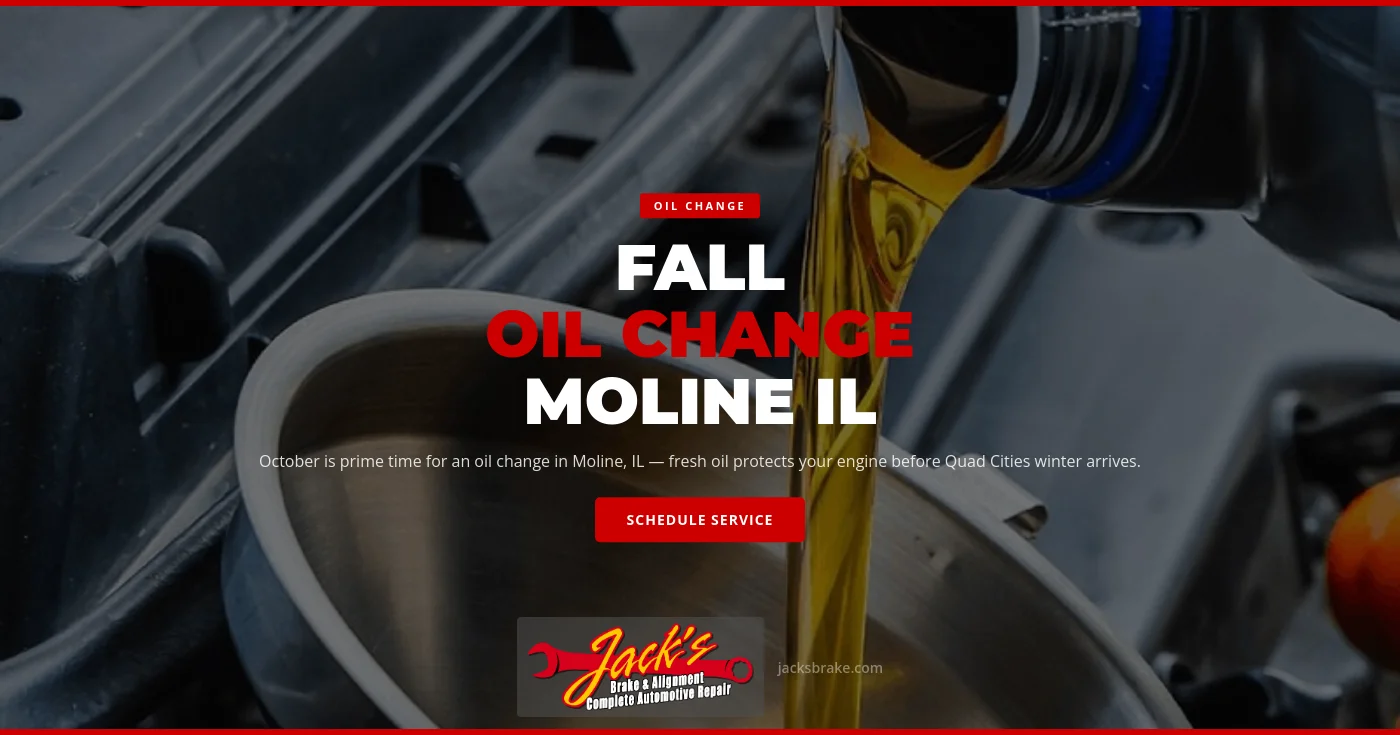
When October mornings start showing frost on windshields in Moline, IL and the first cold commute down John Deere Road reminds everyone that winter is close, there is one piece of maintenance that quietly matters more than any other — the oil change. The engine oil in your vehicle is the thin film that stands between moving metal and expensive repairs, and the way that film performs on a 15°F January morning is almost entirely decided by what you do for it in October. A fall oil change in Moline, IL is one of the most impactful service appointments on our board every year at Jack's Brake & Alignment, and it is one of the few maintenance items where timing really does matter as much as the service itself.
Why Fall Is the Right Time to Change Your Oil in the Quad Cities
Weather in the Quad Cities does not ease into winter — it drops. We watch daytime highs across Moline fall from the 80s in early September to the 50s by late October, and overnight lows dip below freezing well before Thanksgiving. By January, our customers are driving to work in air that routinely sits below 10°F, and that temperature change has real consequences for the oil already in your crankcase. Fresh oil poured in October has months of warmer-weather driving to fully circulate, scrub minor residues, and settle into its working viscosity range. Oil that has already been in your engine for 5,000, 8,000, or 10,000 miles when the cold snaps hit has lost additives, picked up contaminants, and is heading into the hardest season of its life already weakened.
A pre-winter oil change in Moline, IL is also our chance to look at your vehicle under conditions that still allow a comfortable repair window. Catching a seeping valve-cover gasket in October means a one-day job with a loaner car. Discovering the same leak in mid-January, after months of thickened oil has been pushed past a worn seal, often means a bigger repair under less forgiving conditions. The drivers who come in every fall for a routine oil change in Moline, IL spend less across the full year than the drivers who wait until the oil-pressure light shows up on a cold morning.
How Oil Degrades Over Time — and Why Cold Weather Makes It Worse
Motor oil does not simply get dirty — it chemically breaks down. Every mile you drive, your oil is heated past 200°F in the bearings, squeezed through filter media, exposed to combustion byproducts that slip past piston rings, and loaded with microscopic metal particles sheared from normal wear. Over thousands of miles, three things happen in order: the detergent and dispersant additives that keep contaminants in suspension get used up, the viscosity-index improvers that stabilize the oil across temperature ranges shear and lose effectiveness, and finally the base oil itself oxidizes and thickens. By the time oil is noticeably dark and smells faintly burnt on the dipstick, it has already lost a meaningful fraction of its protective ability.
Cold weather accelerates every one of those problems. According to industry guidance summarized by the Car Care Council, the single most wear-intensive moment in your engine's life happens in the first seconds after a cold start — and when the oil is both chemically tired and physically thickened by cold, that wear multiplies. Conventional oil in particular contains naturally-occurring paraffin waxes that stiffen as temperatures drop; those waxes slow the oil's flow to the top of the engine during a cold morning crank, and the valvetrain components up there are the ones that pay the price. A Moline, IL driver who tries to stretch a tired oil change through a Quad Cities winter is quietly paying for it in cam-lobe wear, lifter noise, and timing-chain stretch that will not show up on any invoice until years later.
Conventional vs. Synthetic Oil: Which Is Right for Moline Drivers?
Every oil change in Moline, IL starts with a conversation about what fluid your engine needs, and the real answer is almost always "whatever your owner's manual specifies." Modern automakers test their engines against specific oil grades, and running the wrong fluid can shorten engine life, void a powertrain warranty, or trigger a cascade of oil-related trouble codes. That said, within the range your manufacturer approves, there is often a real choice between conventional, synthetic blend, and full synthetic — and the Quad Cities climate pushes that choice in a clear direction for most drivers.
Conventional oil is refined from crude petroleum and still works perfectly well in older engines and lower-mileage daily drivers whose owner's manuals specifically call for it. For Moline, IL drivers who change their oil every 3,000 to 4,000 miles like clockwork, conventional does the job. Where it struggles is in cold-start viscosity — the paraffin waxes that come with crude-based oil thicken more at Quad Cities winter temperatures, and the additive package in conventional typically has a shorter useful life than synthetic.
Full synthetic oil is engineered from the molecule up. The base stocks are consistent in size, free of waxes, and formulated to resist both oxidation at high temperatures and thickening at low ones. In a Moline, IL driveway at 5°F on a January morning, synthetic pours and pumps measurably faster than conventional, which means the valvetrain is lubricated sooner during the cold-start window where most wear occurs. Full synthetic also carries a stronger additive package and typically supports 7,500 to 10,000-mile service intervals — your owner's manual is still the final word. Synthetic blends sit in the middle, with a cold-weather and interval profile between the two.
For most daily-driver customers who bring their vehicles in for an oil change in Moline, IL, our technicians recommend full synthetic going into winter — the cold-flow advantage alone pays for the price difference over the life of the engine. For fleet, RV, diesel, and high-mileage customers, we build the recommendation around the manufacturer's specification and the way the vehicle is actually used, as part of a broader Auto Maintenance plan.
What Jack's Brake & Alignment's Oil Change Service Includes
Not every oil change is the same work. At a quick-lube chain, the appointment is often a 10-minute drain and refill. A proper oil change in Moline, IL at our shop is a drain, a fluid replacement with the right grade for your engine, a new oil filter, a complete under-vehicle inspection, and a documented record of what we found and what we recommend. That difference matters most in the fall, because fall is when small issues are easiest to catch.
When your vehicle is on our lift for an oil change, our technicians also inspect the belts and hoses for cracks and soft spots that cold weather will expose, check the torque of the oil-pan drain plug and gasket, scan the undercarriage for seeping gaskets or weeping lines, verify the serpentine belt and tensioner, and check tire tread and pressure heading into the season when grip matters most. If your check-engine light is on or a stored code has been quietly logged, we run a free diagnostic scan through our factory-grade equipment and let you know what we found before any further work gets discussed. That diagnostic is part of our broader Engine Diagnostics service, and it is always no-cost on an oil-change visit.
Every service at Jack's comes with a written estimate before any work beyond the quoted oil change begins — nothing gets done without your approval, and there are no surprise fees on the invoice at the end. Routine oil changes at our shop start at $29.99 and include the complimentary multi-point inspection described above. Every repair that follows is backed by our 24-month / 24,000-mile parts and labor warranty through the TechNet Nationwide network, which means the work holds up on the road and travels with you if you break down out of town.
Signs Your Car Is Overdue for an Oil Change
Most Moline, IL drivers who ask us about an oil change are already on top of the service — they track mileage, they watch the maintenance light, and they book when the sticker in the corner of the windshield tells them to. For the rest of us, vehicles will give several honest signals when the oil is tired, and knowing what to look and listen for can prevent the kind of damage that stretches a $29.99 appointment into a $2,000 repair.
The clearest sign is the dipstick itself. Pull it on a cold engine, wipe it, re-insert, and read — healthy oil is translucent amber or light brown and smells faintly of oil but not of fuel or burning. Oil that comes out black, gritty, thick, or smelling scorched has broken down and is overdue. A second cue is the dashboard — modern vehicles track oil condition algorithmically and will illuminate a reminder when the system calculates the oil is spent. A third is sound. If your engine develops a cold-start tick or a top-end rattle that was not there a month ago, the oil has often lost the viscosity needed to lubricate the valvetrain on a cold crank. A fourth is fuel economy — tired oil creates measurably more internal friction, and most drivers who stretch an interval too long will see a quiet one-to-three mile-per-gallon drop before anything else goes wrong.
And the fifth sign, which Quad Cities drivers specifically should pay attention to, is seasonal timing. If your last oil change was more than six months ago, if you drove through a hot summer on the previous service, or if your vehicle has been doing short around-town trips for weeks without a full warm-up, the oil has been through more stress than the mileage number alone suggests. A fall oil change in Moline, IL is the reset that puts you into winter with a known-good lubricant in the crankcase.
Schedule Your Fall Oil Change in Moline, IL Today
The drive from Moline to our shop in Davenport is a short one — across the river on I-74, usually inside fifteen minutes — and it is a trip that saves our Moline, IL neighbors real money and real worry every winter. Since 1965, Jack's Brake & Alignment has been the family-run shop that Moline, Rock Island, East Moline, Davenport, and the rest of the Quad Cities count on for auto repair done the way it should be. Sixty-one years of oil changes performed in the same building, by technicians who average more than five years of tenure with us, shows up in the small details — the right grade of oil for your engine, a filter you can actually trust, a clean torque on the drain plug, and a written record of what we found during the inspection.
Every oil change in Moline, IL at Jack's includes the free diagnostic scan on request, the complimentary multi-point inspection, a written estimate before any further work begins, and the 24-month / 24,000-mile warranty through the TechNet Nationwide network. We offer same-day turnaround on routine oil changes, free loaner cars and free shuttle service if your vehicle needs to stay longer, after-hours key drop-off and pickup, and online appointment setting through our website. Our October Super Saver Deals program adds $15 off purchases over $100, up to $85 off over $800 — which stacks neatly with a tire rotation, an alignment check, or any pre-winter maintenance a Quad Cities vehicle benefits from this time of year. And through October, our 10th annual Brakes for Breast Cancer fundraiser donates 10% of every brake service to Gilda's Club Quad Cities.
If you have been meaning to get your fall oil change in Moline, IL booked, this is the week to do it. Book a pre-winter oil change in Moline, IL with Jack's Brake & Alignment today, and head into Quad Cities winter driving with the confidence that the single most important fluid in your engine is fresh, correct, and ready for the season.