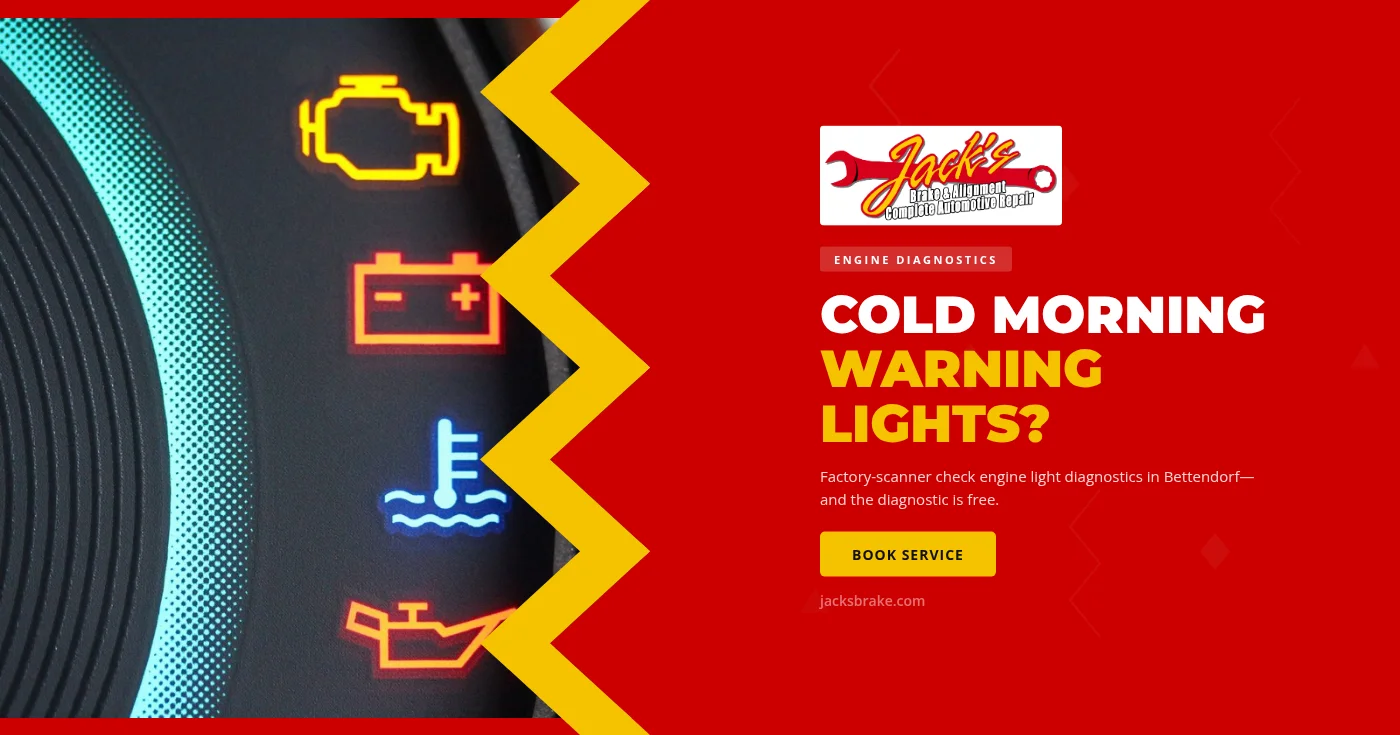
That first frosty November morning has a way of exposing every weak spot under the hood. You turn the key, the engine shudders through a rough idle, and an amber light pops up on the dash. If you’re looking for check engine light diagnostics Bettendorf drivers can trust, you’re in the right place. This is one of the busiest weeks of the year for warning lights at our shop.
Cold air changes how rubber, metal, batteries and fuel behave, and modern engine computers notice every change. Some warnings are minor. Others are early signs of a problem that could leave you stranded on a 10-degree January morning. Here at Jack’s Brakes, we’ve been sorting out the difference for drivers in Bettendorf and across the Quad Cities since 1965.
Below, we cover why lights spike after the first freeze, the most common cold-weather causes, how to tell a solid light from a flashing one, why a free code read isn’t a diagnosis, and how factory scanners find the real cause before winter settles in.
Why Check Engine Lights Spike After Bettendorf’s First Cold Snap
In a typical year, the Quad Cities see a first freeze somewhere around mid-to-late October. By November, it’s common to wake up to temperatures in the 20s and see afternoon highs in the 40s. The National Weather Service Quad Cities office tracks local conditions if you want details for a given week. That swing between your morning commute and your drive home is behind many of the warning lights we see.
Your engine’s computer constantly compares sensor readings against expected values. On a cold start, the engine runs a richer fuel mixture, idle speed rises, and parts that seal perfectly at 70 degrees can shrink just enough to let air or fluid slip past. If a reading drifts out of range long enough, the computer stores a trouble code and turns on the light.
Every car and light truck sold in the U.S. since 1996 uses a standardized system called OBD-II, so the light means essentially the same thing on a minivan or a pickup: something the computer monitors isn’t behaving as it should. Check engine light cold weather problems rarely appear out of thin air. The cold exposes issues that were already developing—a hairline crack in a hose, a tired battery, a spark plug near the end of its life. That’s why so many drivers tell us the light came on the morning after the first hard freeze.
Common Cold-Weather Causes: Sensors, Vacuum Leaks, Thermostats and Misfires
Most cold-snap warning lights trace back to a short list of culprits. Here’s what we find most often this time of year.
Vacuum Leaks and Lean Codes
Rubber vacuum hoses and intake gaskets contract in the cold. A hose that was barely sealing in September can crack open on a frosty morning, letting unmetered air into the engine. The computer reads that as a lean condition and often sets a code such as P0171. The catch: that same code can also point to a dirty mass airflow sensor, weak fuel pressure or an exhaust leak.
Thermostats Stuck Open
A thermostat that sticks open keeps the engine from reaching normal operating temperature, which commonly triggers P0128. You may also notice weak cabin heat and lower fuel mileage—two things nobody wants heading into a Midwest winter.
Weak Batteries and Electrical Glitches
Batteries lose a large share of their cranking power as temperatures fall; some industry estimates put the loss at 30 percent or more near zero. Low voltage during a cold start can confuse sensors and modules and leave behind odd, unrelated codes. Our electrical and fuel system repair team tests the battery, charging system and wiring before anyone replaces parts.
Cold-Start Misfires and Rough Idle
Worn spark plugs and aging ignition coils are more likely to misfire when the engine is cold. A rough idle cold start that smooths out after a few minutes is often the first clue, and it may set codes from P0300 to P0308. One more note: tire pressure drops roughly 1 PSI for every 10-degree temperature drop, and that low-tire warning gets mistaken for a check engine light more often than you’d think.
Solid vs. Flashing Check Engine Light: When to Pull Over and When to Schedule
Not every check engine light carries the same urgency, and the way it lights up tells you a lot.
A solid light means the computer has found a fault and stored a code. It’s rarely an emergency, but it does need attention. Common triggers include a loose gas cap, an evaporative system leak, a failing oxygen sensor or a minor vacuum leak. If the car drives normally, schedule a diagnostic within the next few days rather than waiting weeks.
A flashing light usually signals a severe misfire. Unburned fuel is entering the exhaust, where it can overheat and damage the catalytic converter—one of the more expensive parts on your vehicle. The U.S. EPA’s guidance on on-board diagnostics explains that the system is designed to catch problems early, before they raise emissions and lead to bigger repairs. Your owner’s manual will typically advise prompt service when the light flashes.
If your light is flashing:
- Ease off the accelerator and avoid hard acceleration or towing.
- Get off the road as soon as you can do so without risk.
- Skip long trips until the vehicle has been checked.
- Call for a tow if the engine is shaking badly or losing power.
We offer free towing and loaner cars with repair, so a flashing light doesn’t have to wreck your week.
Why a Free Code Read Isn’t the Same as a Real Diagnosis
Plenty of drivers ask whether auto parts store code readers tell you the real problem. The short answer is no—not on their own.
A trouble code points to a symptom or a circuit, not a specific failed part. Take P0171 again. A basic reader might suggest an oxygen sensor, but the real cause could be a cracked vacuum hose, a dirty airflow sensor, a weak fuel pump or a leaking intake gasket. Replace the wrong part and the light comes right back, along with a bill for something you didn’t need.
Basic readers have other limits, too:
- Many can’t see manufacturer-specific codes.
- Most can’t reach ABS, transmission, body or diesel aftertreatment modules.
- They don’t show live data like fuel trims or per-cylinder misfire counts.
- They can’t run tests that command components on and off.
A real engine misfire diagnosis combines the code with live data, freeze-frame information, a visual inspection and targeted testing. That’s the difference between guessing and knowing. Here at Jack’s Brakes, the diagnostic is free, so a real answer costs you no more than a code read.
How Factory Scanners Pinpoint the Problem on Cars, Trucks, Diesels and Fleets
Factory scanner diagnostics are one of our specialties. Factory-level tools speak the same language as dealer equipment, which lets our technicians see far more than a generic reader ever could.
What Factory-Level Tools Show Us
- Live data: fuel trims, coolant temperature, sensor voltages and misfire counts by cylinder.
- Freeze-frame data: exactly what the engine was doing when the code set, including temperature—ideal for tracking down cold-start faults.
- Bi-directional controls: commanding fans, valves, injectors and relays on and off to confirm what works.
- Full network access: every module on the vehicle, not just the engine computer.
Cars, Light Trucks, Diesels and Fleet Vehicles
We work on domestic, Asian and European vehicles, plus diesels, RVs, classic vehicles and heavy-duty trucks. Cold weather is especially hard on diesels: glow plug faults, fuel gelling and DEF or DPF warnings all pick up as temperatures fall. DEF can begin to freeze around 12°F, which helps explain why aftertreatment warnings often show up on the coldest mornings.
For businesses running work trucks through late harvest and early winter, downtime is expensive. Our fleet and RV repair service pairs factory diagnostics with DOT inspections and large vehicle alignments, so one visit can cover more than one need. And with quick availability for most work and same-day service on routine jobs, we help keep your vehicles moving.
What Happens If You Ignore a Check Engine Light Going Into Winter
Iowa doesn’t currently run a vehicle emissions testing program, so nothing outside forces you to deal with a lit check engine light. It’s tempting to drive on it until spring, but winter is the worst season to gamble:
- A small vacuum leak can lead to stalling at a cold stop sign.
- A misfire left alone can damage the catalytic converter.
- A stuck-open thermostat means weak heat and poor defrost on icy mornings.
- A weak battery or charging fault can strand you when temperatures hit single digits.
- A light that’s already on can’t warn you about a second, more serious problem.
That last point matters most. Once the light is lit, a new fault won’t change anything on your dash. Thanksgiving road trips, daily commutes over the I-74 bridge and early job sites all go smoother when you know exactly what’s happening under the hood. Handling it now usually means a smaller repair and fewer surprises.
Frequently Asked Questions About Check Engine Light Diagnostics in Bettendorf
Why does my check engine light come on when it’s cold, then go off?
Some faults appear only under certain conditions, like a hose that leaks until the engine warms up. The computer may turn the light off after several clean drive cycles, but the code is usually still stored. We can read that history and track down the intermittent cause.
Can I keep driving with a flashing check engine light in winter?
We don’t recommend it. A flashing light usually means a severe misfire that can damage the catalytic converter. Limit your driving and have it checked right away—or let us tow it in free with repair.
How much does engine diagnostics cost in Bettendorf, IA?
Here at Jack’s Brakes, the diagnostic is free. You’ll get a written estimate, and no work is performed without your approval.
Will disconnecting the battery clear the light?
It may turn the light off temporarily, but it also erases helpful freeze-frame data and resets readiness monitors. If the fault is still there, the light will come back. Let us find the cause first.
Schedule Check Engine Light Diagnostics in Bettendorf Before Winter
A cold-morning warning light is your vehicle asking for attention before winter gets serious. With factory scanners, a free diagnostic and quick availability for most work, we make it easy to find the real cause and fix it right. Repairs are backed by our 24-month/24,000-mile parts and labor warranty through the TechNet Nationwide Warranty network.
For 61 years, we’ve served drivers in Bettendorf, Davenport, Pleasant Valley and across the Quad Cities with friendly service, clear communication and fair pricing. Ready for answers? Contact Jack’s Brakes to schedule your check engine light diagnostics in Bettendorf today.
Where can I get my check engine light diagnosed near Bettendorf?
We make it easy to get a real answer when a warning light shows up on a cold morning. Our technicians use factory-level scanners on domestic, Asian and European vehicles, diesels, RVs, classic vehicles and heavy-duty trucks, so we see the same data the dealer sees—without the dealer wait.
When you bring your vehicle to us for engine diagnostics, here’s what you can expect:
- A free diagnostic and free written estimates
- No work performed without your approval and no surprise fees
- Quick availability for most work, with same-day service on routine jobs
- Free towing with repair, free loaner cars and a free shuttle
- A 24-month/24,000-mile parts and labor warranty through the TechNet Nationwide Warranty network
- Financing options through Snap Finance and Koalafi
Our comfortable waiting area has free WiFi, snacks, device charging and a quiet work space, and it’s pet-friendly too. Prefer to drop off early or late? We offer after-hours key drop-off and pickup.
We’ve been part of the Quad Cities since 1965, and we’d love to help you head into winter with peace of mind. You can set an appointment online or check our current coupons before your visit.